Domicella Bożekowska’s animalistic sculptures and drawings reflect her fascination with nature, her talent and her impeccable technique. A temporary exhibition of her works is on display at the Cantonists’ Barracks – the first such representative presentation of this eminent artist in many years. Domicella Bożekowska
Cantonists’ Barracks
Tickets: PLN 30 – standard ticket, PLN 15 – reduced ticket, PLN 20 – adults with a Large Family Card, free admission on Fridays (individual visit only)
Domicella Bożekowska’s animalistic sculptures and drawings reflect her fascination with nature, her talent and her impeccable technique.A temporary exhibition of her works is on display at the Cantonists’ Barracks – the first such representative presentation of this eminent artist in many years.
Domicella Bożekowska – sculptor, illustrator and filmmaker – devoted nearly her entire creative life to in-depth studies of animal behaviour. A sensitive and attentive observer, her subtle, sketched or sculpted representations captured the essence of each creature: its habits, movements and modes of communication.
Today, against the backdrop of debates on animal rights and the destructive impact of civilisation on ecosystems – discussions that increasingly intersect with the arts – Bożekowska’s stance feels remarkably topical. Surprisingly, though, in the latter half of the 20th century, animal-themed art held little appeal in Polish artistic circles, whether among creators or audiences. At that time, choosing to focus almost exclusively on animals might well have been seen as a bold gesture. It brought limited opportunities to exhibit work, since the subject lay outside the artistic mainstream. This helps explain why Bożekowska has remained largely under the radar. Now, however, her art is being rediscovered and appreciated.
The City of Animals – what will we see at the exhibition?
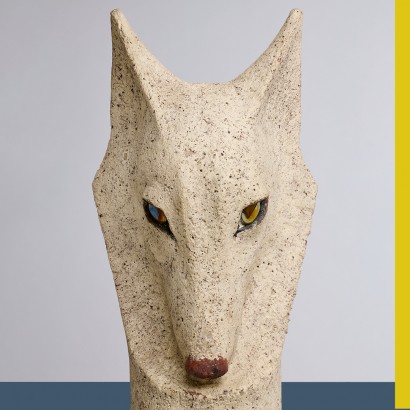
The City of Animals. Domicella Bożekowska invites viewers into the artist’s world – one shaped by her fascination with nature, her talent and her impeccable technique. The selection of sculptures and sketches on display attests to Bożekowska’s sensitivity and her remarkable gift for observation. Her works reveal a curiosity worthy of a naturalist. The artist consciously abandoned realism in favour of simplified, synthetic forms – a tendency also present in Polish sculpture of the 1950s and 60s. Her depictions of animals testify to her excellent anatomical knowledge. The minimalism of her forms and the precision with which she captured characteristic behaviours are striking. Bożekowska had an exceptional ability to convey both movement and the stillness of an animal’s pose. She portrayed many species: buffalo, elephants, foxes, horses, deer and tigers. Yet it was wolves that held a special fascination for her. Some of the animals she depicted – such as Fuga, a female half-wolf, half-dog; Kitu the mongoose; or the ferret Pandulek – were part of the artist’s own family.
Bożekowska often created works with specific spaces in mind – gardens, parks or small urban squares. One such sculpture is Wild Boar, made in the 1960s or 70s, which can still be seen today at the Warsaw Zoological Garden. We present this work near the entrance to the building housing the exhibition.
Also on display are photographic records of the artist’s work from her private archive, as well as three chisels she used in her practice.
The exhibition at the Royal Łazienki Museum is the first such representative presentation of Bożekowska’s work in many years, bringing together pieces from various periods and carefully curated to highlight her distinct approach to portraying animal subjects
The exhibition is curated by Kalina Cukrowska, with Anna Szary as co-curator and coordinator.
Opening hours and admission
The exhibition is open from 9 a.m. to 4 p.m. (Tue-Wed), from 10 a.m. to 6 p.m. (Thu-Sat), and from 10 a.m. to 4 p.m. (Sun). Last entry is 30 minutes before closing time. Admission as part of the ticket to the Cantonists’ Barracks: 30 PLN – regular, 15 PLN – reduced, 20 PLN – adults with a Large Family Card, 1 PLN – children aged 7+ and young people under 26; members of the Friends of the Royal Łazienki Museum Club – free of charge; Fridays are free of charge. Tickets can be purchased at the ticket office in the Officer Cadets School, the Old Orangery and the Kubicki Stables.
Domicella Bożekowska (1927–2019) began developing her sculptural skills at the School of Woodcraft in Jelenia Góra, where she moved with her family after the war. Their home in Warsaw had been destroyed during the Uprising, and her father had found work in the region. She later continued her artistic education at the Academy of Fine Arts – first in Kraków, then in Warsaw – studying under Professors Tadeusz Breyer and Marian Wnuk. After receiving her degree in sculpture in 1953, she went on to study veterinary medicine for two years at the Warsaw University of Life Sciences, subsequently pursuing independent studies in botany and ecology. In 1967, Bożekowska met sculptor and architect Andrzej Goryński, who became her husband and co-authored several of her art projects. Their shared life was marked by mutual passions: art, the observation of animals and a deep concern for the natural environment. In the 1970s, Bożekowska’s work was exhibited in prominent galleries run by the Association of Polish Artists and Designers in Warsaw. Sculpture in the Garden (1970) was displayed in a green courtyard space; Fuga (1971) explored interspecies relationships and the emotional bond between humans and animals. Respect the Greenery (1972), created together with Goryński, expressed their protest against environmental degradation and the commodification of nature. They also collaborated on Public Enemy No. 1 (1978), an artistic manifesto in defence of Poland’s wolves, which were then on the brink of extinction. In the early 1980s, Bożekowska and Goryński emigrated to Germany. From the 1990s onwards, they divided their time between Darmstadt and Warsaw. Bożekowska’s works were presented in numerous solo and group exhibitions, both in Poland and internationally – including in Warsaw, Vienna, Berlin, Prague, Sofia, Kathmandu, New Delhi and Cologne.