‘A Man Watering a Bay Horse’. A New Painting in the Museum’s Collection
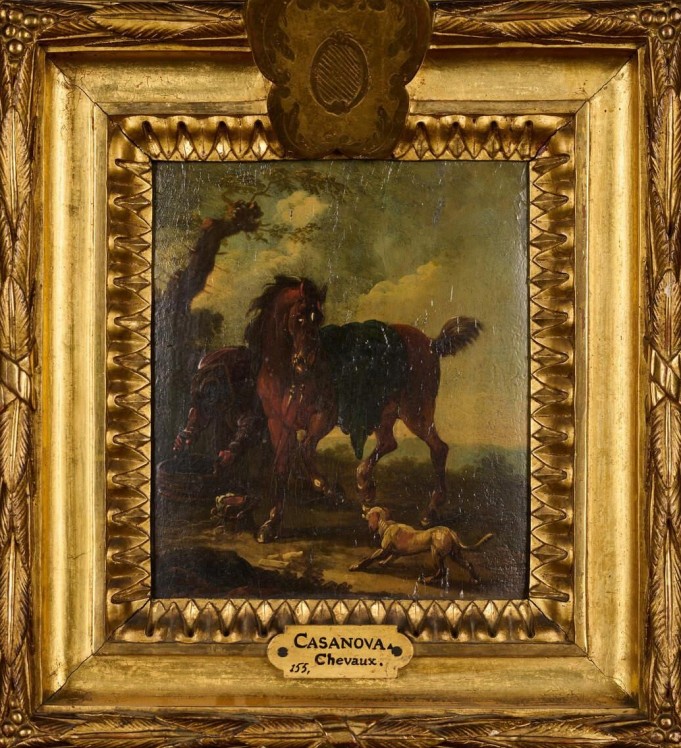
The Royal Łazienki Museum’s collection has been enriched by another painting from the collection of King Stanisław August. The small-scale work ‘A Man Watering a Bay Horse’, attributed to the circle of Francesco Giuseppe Casanova, has returned to Poland after more than a century. As part of the ‘Free November’ campaign, the painting can be seen in the Picture Gallery at the Palace on the Isle.
In the inventory of Stanisław August’s collection, ‘A Man Watering a Bay Horse’ was listed as number 1664. It formed a pair with a second painting of a similar subject, now lost. Pairs of paintings matched in subject and format, known as pendants, were very popular in eighteenth-century collections.
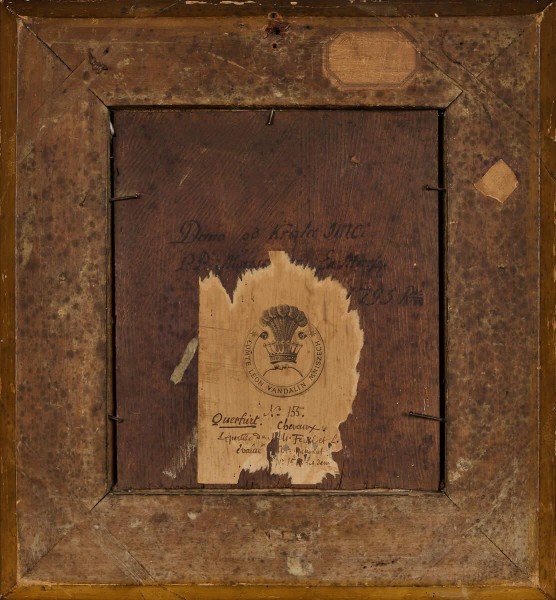
In the king’s time, both works hung in the Royal Castle, in the apartments of his sister, Ludwika Zamoyska, née Poniatowska (1728–1804). Unlike most of Stanisław August’s collection, which was later sold off by his heirs, the pendants ‘in the manner of Casanova’ were given by the king on 5 January 1795 to his niece – Ludwika’s daughter – Urszula Mniszech, née Zamoyska (1750–1806). For more than a century, the paintings’ fortunes were bound up with the Mniszech family. Shortly after the middle of the nineteenth century, Andrzej Mniszech (1823–1905) moved the family collection to Paris, where he settled in a house on rue Daru. A discerning collector, he was also an amateur artist who painted portraits in the style of the seventeenth-century Dutch masters. ‘A Man Watering a Bay Horse’ and its pendant remained with the Mniszech family until 1902, when they were sold at auction at the Galerie Georges Petit in Paris. After that, all trace of both paintings was lost until 2025, when one of them surfaced in a private collection in Poland. Evidence of the work’s rich history – old inscriptions and a label bearing the Mniszech coat of arms – can be found on the reverse of the painting.
‘In the manner of’ Casanova
Although the subject and painterly conventions of ‘A Man Watering a Bay Horse’ are close to the work of Francesco Giuseppe Casanova, he cannot be regarded as its author. Even in Stanisław August’s collection, the work was described as ‘in the manner of’ this artist. Autograph works by Casanova were well represented in the royal collection: the inventories list as many as 19 paintings, mainly of horsemen and of animals at pasture. This was undoubtedly thanks to Marcello Bacciarelli, who knew Casanova personally and promoted his work at Stanisław August’s court. From 1767 onwards, commissions for Casanova arrived regularly from Warsaw. Three of the paintings ordered at that time can still be seen today in the Study next to the Solomon Room.
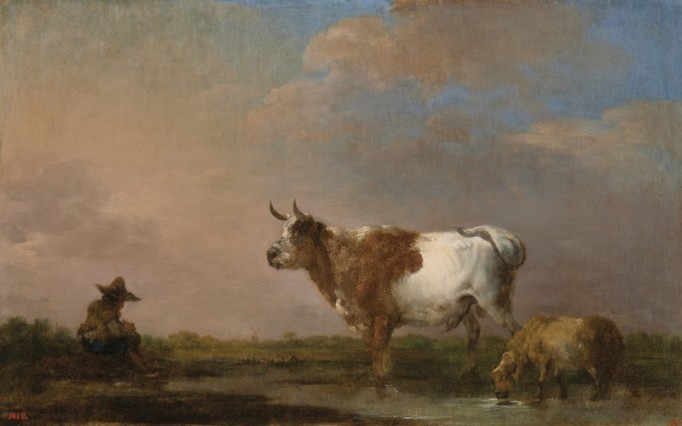
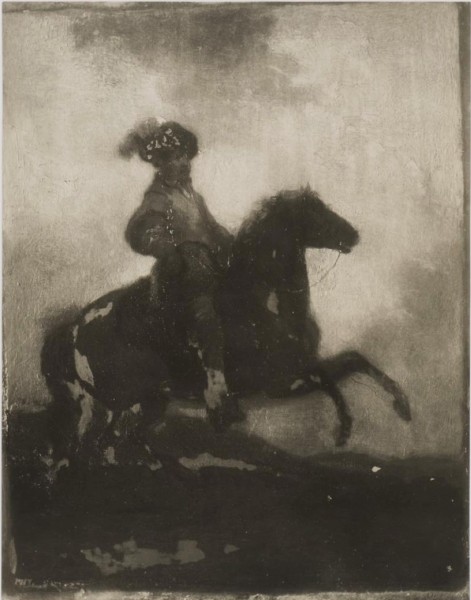
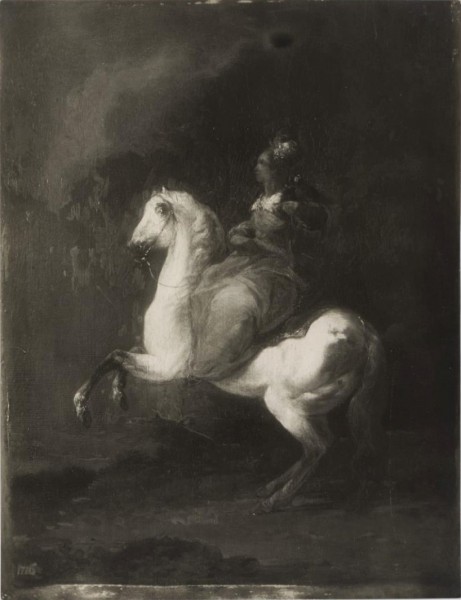
The fact that Casanova’s work was well known in Warsaw, and that paintings were commissioned directly from the artist, explains why ‘A Man Watering a Bay Horse’ was described merely as ‘in the manner of’ Casanova. Interestingly, until the Second World War the Palace on the Isle housed two paintings by Casanova that provide a useful point of comparison for the newly acquired work. These small pictures showed a woman and a man on horseback. The horses were depicted in dynamic poses against a broad landscape; one was white, the other bay.
A scattered collection
Stanisław August’s collection of paintings numbered almost 2,500 works, of which only a small part survives in Polish collections today. The largest number of the king’s paintings can be seen at the Palace on the Isle, which was conceived from the outset as a setting for the most important part of the royal collection. The Royal Łazienki Museum regularly acquires paintings with a Stanisław August provenance. ‘A Man Watering a Bay Horse’ is the latest example, following Marcello Bacciarelli’s ‘Portrait of Andrzej Poniatowski’ and Jacob Philipp Hackert’s ‘Fishermen and a Boat by the Bay’, acquired in 2022 and 2023 respectively. The purchase of the painting was co-funded by the H. Konopacka Lotto Foundation.